

Essential Safety Research has acknowledged how on a regular basis practices, equivalent to CCTV operation, have embedded safety considerations more and more in on a regular basis life (Huysmans 2011). Social media has dramatically escalated this course of, “democratising” the power of the person to “communicate” safety and develop into producers of the speech acts, so central to the elite centric work of the Copenhagen College (Buzan et al. 1997) and the generations of safety students that they impressed. As we’re ever extra immersed within the social media age, it’s ever extra important that important safety research, and worldwide relations extra broadly, completely and critically engages with theoretical and empirical challenges introduced by the digital communications revolution.
That is particularly necessary for the discursive flip in safety research since, whereas people nonetheless have little materials management of the safety surroundings, they more and more have the power to form the safety debate. The constructivist flip in safety research started with the elite centric Copenhagen College (Buzan et al. 1997). Right here, elites competed to construction safety debates and threats and transfer points between emergency and non-emergency politics. Nevertheless, the hierarchical nature of this work leaves little room for understanding how “non-elites” talk about, redefine and contest safety narratives. Thus, the Copenhagen faculty can not provide a conceptualisation of how constructivist notions of safety apply outdoors of the context of the elite.
A up to date response has been vernacular safety research (Bubandt 2005; Jarvis 2019) which contemplate the voice of non-elite actors inside safety debates. This brings “lay” actors into the equation, providing insights into how safety is constructed via native idioms. This, nonetheless, doesn’t enable for a conceptualisation of the strain between the democratised panorama of social media which can also be replete with hierarchies of affect. Thus, whereas social media gives necessary perception into vernacular safety communicate, it’s not fully “flat” and a few vernacular communicate turns into “extra equal” than others. Social media presents constructivist safety students with a theatre of research sitting someplace between the “flat” airplane of vernacular and hierarchical notions of the Copenhagen faculty in that, while anybody theoretically can “communicate” safety on social media, only some will develop into influential doing so. This text contributes to understandings of constructivist safety via analysing social media outputs to grasp who’s influential within the safety debate and the way. Working on the intersection of “flat” vernacular and “hierarchical” Copenhagen College understandings of safety, it identifies mechanisms of safety influencers’ rise to prominence, chatting with the truth of the social media panorama that renders safety communicate neither radically flat nor rigidly hierarchical. This permits incorporation of notions of non-elite actors talking safety in ways in which allow novel theoretical insights for each faculties of important safety.
Influencers are primarily thought-about inside advertising and marketing as representing impartial third-party endorsers shaping viewers attitudes via shared on-line content material. Though there have been vital educational definition influencers (Bakshy et al. 2011) and quantifying affect (Anger and Kittl 2011) there’s little consideration of typologies. This presents necessary areas by which we are able to contemplate how people develop into influential inside key safety debates. We used an modern mixture of discourse and social community evaluation to grasp the contours of the social media panorama and the way influencers emerged within the 48 hours after the Manchester bombing on Twitter.
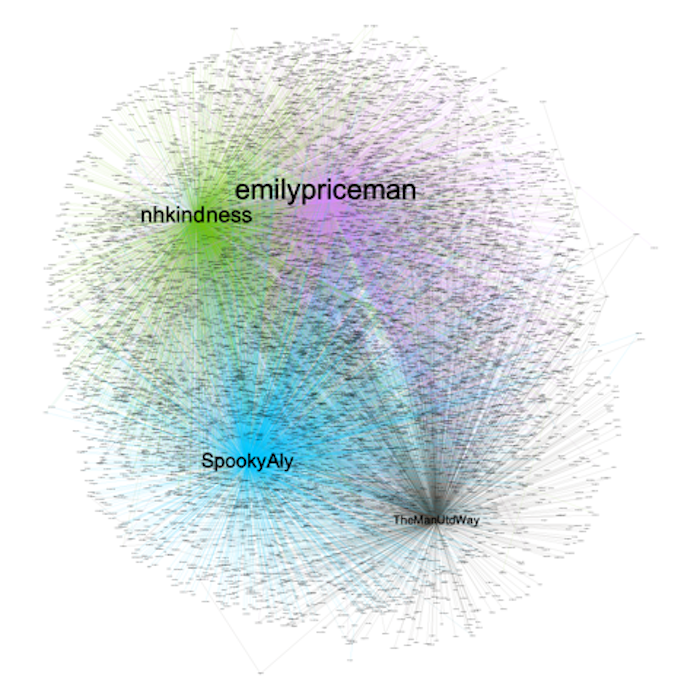
Determine 1: Visualisation of the 4 most influential sub-network buildings.
Social community evaluation Social community evaluation of Twitter information provides insights into “affect” as a result of it identifies who’s central to safety communicate in any given context. The SNA additionally demonstrates how influencers’ conversations have little interplay with others: conversations analysed stay discrete and contestation/settlement happen inside particular clusters with out spreading, although they emerge thematically and are empirically comparable in message. Nevertheless, it shouldn’t be mistakenly assumed that “affect” is a synonym of “settlement” as a big quantity of engagement that drives a person or hashtag (#) into prominence on social media comes within the type of contestation or value-neutral engagements. Our paper established this within the safety context as we utilized each discourse and sentiment analyses to all tweets inside the 4 influential networks. This enabled us to grasp not solely how tweets have been engaged with, however importantly on what phrases they have been engaged with a what drove this specific safety debate.
Our outcomes recognized a typology of 4 sorts of safety influencers inside the dialogue of Muslims within the aftermath of the Manchester bombings.
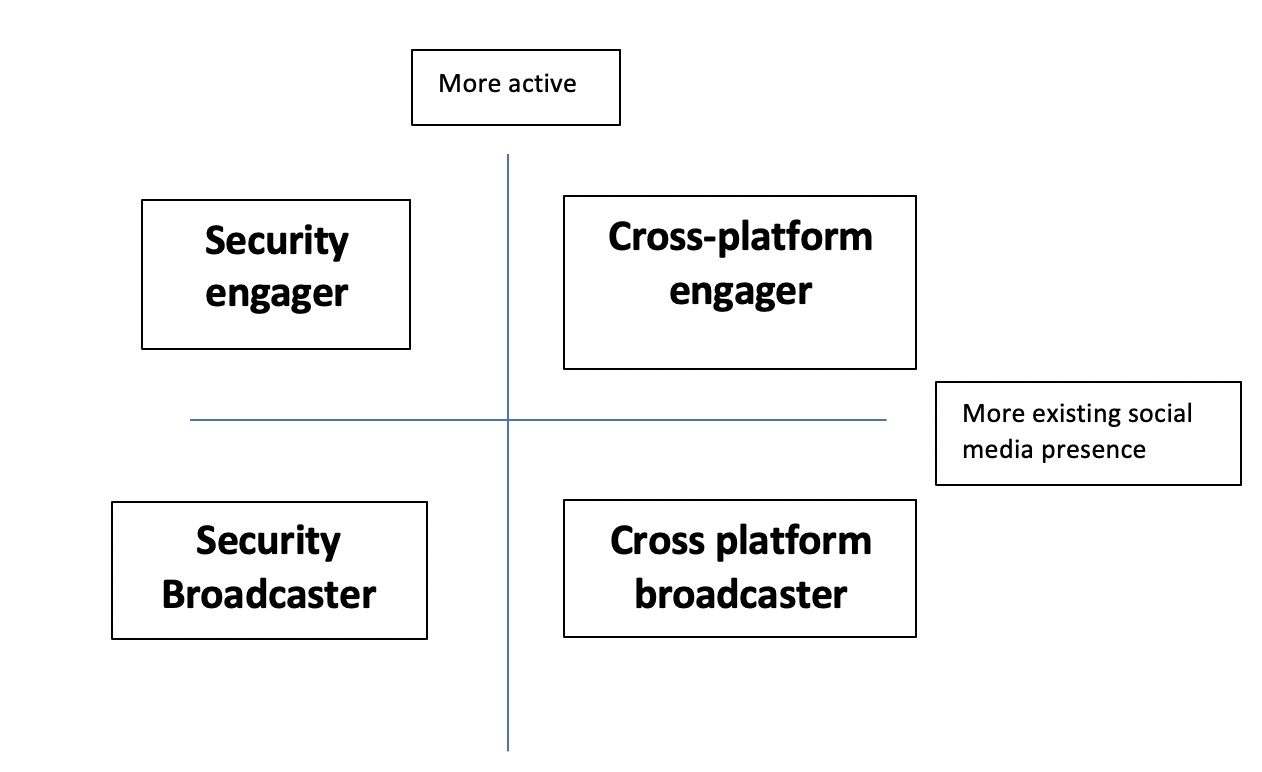
Determine 2: Typology of safety influencers
These 4 sorts of influencers reveal the undulations and complexities of the hierarchies of safety communicate on social media. The primary sort of influencer the “safety broadcaster”. The sort of safety influencer merely broadcasts a message that turns into influential with out additional engagement from the influencer. That is fascinating as a result of important safety research conceptualise elite generated safety discourse on this approach. The Copenhagen faculty sees the elite as able of energy projecting their safety narratives to the viewers (Huysmans 2011). Nevertheless, this particular person doesn’t should have earlier types of social media affect. As such they don’t seem to be even amongst the ranks of the social media “elite” however somewhat rise, with none specific purpose apart from the salience of their message at that second, to prominence after which fall again to obscurity once more. This demonstrates the unpredictability of the social media panorama and presents challenges to students who wish to construct a concept on. Nonetheless, the opposite sort of “passive” broadcaster recognized did have some “elite” credentials on social media – however from a complete safety unrelated area as a brilliant fan of a specific pop star. Thus, the cross-platform broadcaster has present influencer capital in a non-security area that they pivot to discussing safety. Each varieties of broadcaster reveal some fascinating features of the elevated immersion in safety debates skilled by non-elites and the way they’re now assured to specific opinions on safety points.
Different influencers are far more energetic and comply with up their preliminary messages with additional engagements with different social media customers, particularly those that contest their preliminary messages and don’t agree with them. The safety engagers not appearing merely like conventional safety elites conceptualised by the Copenhagen faculty (Buzan et al. 1997) who “broadcast” their message to the viewers, however somewhat they interact additional with responses to their messages on social media. Once more, nonetheless, we establish the unpredictability of this course of as one of many safety broadcasters has no earlier social media capital nor safety credentials and rises to prominence to solely fall again into obscurity. Nevertheless, the cross-platform engager may be very completely different in that they pivot present social media affect from a non-security area into the safety dialogue. On this case a Manchester United fan account with vital present affect within the area of sports activities pivots to have interaction within the safety debate. This demonstrates the elevated enmeshment of safety with on a regular basis social and cultural themes, with soccer team-based types of identification being established as necessary in expressions of discursive resistance to the so-called Islamic State (Downing 2020).
A broader theme inside safety speaks additionally emerges that cuts throughout each the energetic safety engagers and the passive safety broadcasters. That is the distinction within the stability of contestation and settlement that’s current relying on how the broadcasters depict Muslims/Islam inside the Manchester bombings context. Elevated contestation was recognized when influencers structured their safety communicate on the defence of Islam as an summary world faith. Such a course of resulted in different social media customers being extra prone to disagree with their messages and reply with tropes of Islam being inherently susceptible to supply violence and extremism. Nevertheless, when the defence was structured round a defence of Muslims as a social group, customers have been extra prone to agree and differentiate Muslims as a social group from terrorism and violent extremism. That is necessary as social media customers right here instantly join Muslims to the native context of Manchester. Thus, this evidences discursive processes of the “banalisation” (Downing 2019) of Muslims as a social group via their connection to on a regular basis social roles as a substitute of the distinctive episodes of acts of non secular and political violence.
Social media is clearly beneath conceptualised in important safety research at nearly each flip. The Copenhagen faculty, some 20 years previous, seems more and more restricted on the subject of understanding safety communicate on social media, with the few exceptions of “safety elites” equivalent to President Trump, who used social media to such impact to supply and disseminate speech acts. Nevertheless, the Copenhagen faculty provides the chance to conceptualise hierarchies of significance once we contemplate competing safety narratives in any given scenario that also exist on social media because of discrepancies of affect between social media customers. This challenges dominant conceptions that the communications revolution led to by social media is universally democratising. We will see inside Manchester that there is no such thing as a method for deciding who on social media rises to prominence as a safety influencer in any given context, and safety affect on this case is ephemeral and short-lived.
The more moderen vernacular flip in CSS is under-utilised when contemplating the social media panorama. Vernacular voices on safety come from quite a lot of sudden areas – equivalent to soccer or music followers – and thus we have to contemplate how the more and more enmeshment of safety with the on a regular basis twists and shifts safety narratives in sudden methods. Nevertheless, a dominant distinction stays the place between narratives about Muslims as relatable human beings in a particular social context, and the extra summary discussions of Islam as a world faith, the place social media customers are clearly literature in dominant debates about relationships between terrorism and faith. Inside this the “native” “banal” Muslims are simply distinguished from those that commit acts of mass violence, whereas nice suspicion is directed at Islam as a faith.
This text builds on an open entry publication in New Media & Society
References
Anger, Isabel, and Christian Kittl. 2011. “Measuring Affect on Twitter.” In Proceedings of the eleventh Worldwide Convention on Information Administration and Information Applied sciences – i-KNOW ’11, 1. Graz, Austria: ACM Press. doi:10.1145/2024288.2024326.
Bakshy, E, J Hofman, W Mason, and D Watts. 2011. “Everybody’s an Influencer | Proceedings of the Fourth ACM Worldwide Convention on Net Search and Knowledge Mining.” In . https://dl.acm.org/doi/10.1145/1935826.1935845.
Bubandt, Nils. 2005. “Vernacular Safety: The Politics of Feeling Protected in World, Nationwide and Native Worlds.” Safety Dialogue 36 (3): 275–96. doi:10.1177/0967010605057015.
Buzan, Barry, Ole Waever, and Jaap de Wilde. 1997. Safety: A New Framework for Evaluation. UK ed. version. Boulder, Colo: Lynne Rienner Publishers.
Downing, Joseph. 2019. French Muslims in Perspective: Nationalism, Submit-Colonialism and Marginalisation beneath the Republic. Palgrave Macmillan. https://www.springer.com/gb/guide/9783030161026
———. 2020. “Memeing and Talking Vernacular Safety on Social Media: YouTube and Twitter Resistance to an ISIS Islamist Terror Risk to Marseille, France.” Journal of World Safety Research. doi:10.1093/jogss/ogz081.
Huysmans, Jef. 2011. “What’s in an Act? On Safety Speech Acts and Little Safety Nothings.” Safety Dialogue 42 (4–5): 371–83. doi:10.1177/0967010611418713.
Jarvis, Lee. 2019. “Towards a Vernacular Safety Research: Origins, Interlocutors, Contributions, and Challenges.” Worldwide Research Evaluation 21 (1): 107–26. doi:10.1093/isr/viy017.


